
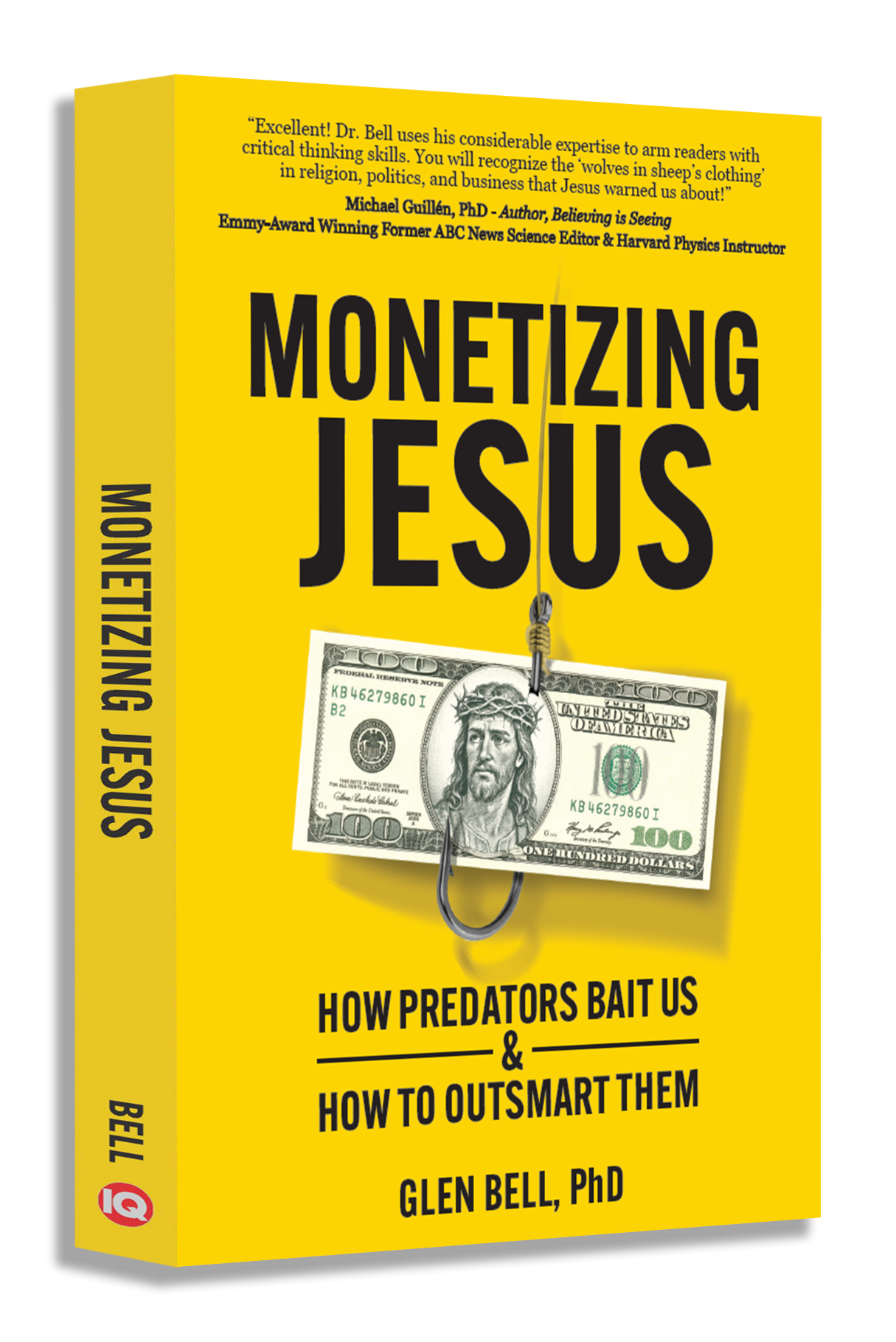
A Pew Research study showed that 92% of American adults hold some kind of spiritual belief. Most Americans believe in God, Jesus, Buddha, Mohammad, an afterlife, or the supernatural. While exploring the spiritual realm is fascinating, it also presents a space that has long been exploited by high-demand religions, con artists, abusers, and other predators. “Monetizing Jesus” spotlights the predatory behaviors that bait followers with Jesus or other esteemed figures. Predators initially promote noble values of “mind, body, and soul” but subtly shift to their real agenda of “power, sex, and money.” The problem is that predators cause significant harm through their charming but totalitarian schemes. Behind their slick narratives, a predator’s dogmas and rituals contribute little to solving the world’s real troubles. They put God behind a paywall.
The genius of Jesus is that he shook up the status quo and taught his followers to test the evidence. He seemed to love a good debate. In an egocentric and sociocentric society, Jesus introduced a fresh, world-centric perspective. The real Jesus rejected a materialistic lifestyle. He had a global concern for the poor, hungry, sick, imprisoned, and elderly. Jesus’ harshest criticisms targeted hypocritical church leaders and child abusers.
The solution lies with principled people who share these values. They are evidence-based, insist on full financial disclosures and getting the complete story from all sides. Principled people reject motivated reasoning, undue influence, and logical fallacies. Of course, they report any allegations of crime to law enforcement. “Monetizing Jesus” examines predator-prey dynamics and principled worldviews. Regardless of one’s spiritual beliefs or unbelief, principled people think critically, go beyond their comfort zones, judge less, and understand more. All of this is in an effort to think globally, stand for something, and contribute to humanity.
Monetizing Jesus: How Predators Bait Us & How to Outsmart Them
A Pew Research study showed that 92% of American adults hold some kind of spiritual belief. Most Americans believe in God, Jesus, Buddha, Mohammad, an afterlife, or the supernatural. While exploring the spiritual realm is fascinating, it also presents a space that has long been exploited by high-demand religions, con artists, abusers, and other predators.
“Monetizing Jesus” spotlights the predatory behaviors that bait followers with Jesus or other esteemed figures. Predators initially promote noble values of “mind, body, and soul” but subtly shift to their real agenda of “power, sex, and money.”
The problem is that predators cause significant harm through their charming but totalitarian schemes. Behind their slick narratives, a predator’s dogmas and rituals contribute little to solving the world’s real troubles. They put God behind a paywall.
The genius of Jesus is that he shook up the status quo and taught his followers to test the evidence. He seemed to love a good debate. In an egocentric and sociocentric society, Jesus introduced a fresh, world-centric perspective.
The real Jesus rejected a materialistic lifestyle. He had a global concern for the poor, hungry, sick, imprisoned, and elderly. Jesus’ harshest criticisms targeted hypocritical church leaders and child abusers.
The solution lies with principled people who share these values. They are evidence-based, insist on full financial disclosures and getting the complete story from all sides. Principled people reject motivated reasoning, undue influence, and logical fallacies. Of course, they report any allegations of crime to law enforcement.
“Monetizing Jesus” examines predator-prey dynamics and principled worldviews. Regardless of one’s spiritual beliefs or unbelief, principled people think critically, go beyond their comfort zones, judge less, and understand more. All of this is in an effort to think globally, stand for something, and contribute to humanity.
About the Author
Randall Bell, PhD, is a sociologist and economist who specializes in disaster recovery projects.
No stranger to how harsh the world is, Dr. Bell has consulted in more tragedies around the world than anyone. He was retained for the World Trade Center, Flight 93, Sandy Hook, BP Oil Spill, Hurricane Katrina, the Bikini Atoll Nuclear Test sites, the BP Oil spill, the Northridge earthquake, OJ Simpson, Jon Benet Ramsey, Heaven's Gate, and hundreds of other cases. He has been retained by the Federal Governments of the United States, Canada, and Australia to help resolve numerous crises, and his work has generated billions of dollars to rebuild damaged communities.
Dr. Bell’s investigations have taken him to 50 states, and seven continents. Having met with countless victims, he earned the nickname of Master of Disaster. In every case, Dr. Bell observed the emotional consequences and how some fared better than others. He was inspired to put his unique research skills to work and study the cycle of trauma.
A frequent guest of the media, Dr. Bell is the featured expert in Topic’s “Distressed Real Estate” documentary series directed by Jason Stefaniak. His career has been profiled by NBC's Today Show, Rolling Stone Magazine, The Wall Street Journal, People Magazine, ABC's 20/20, Hallmark’s Home & Family, and many others.
Dr. Bell is the author of MeWeDoBe and the founder of Core IQ, a non-profit educational foundation that provides free online training on life skills. He is certified through the Insight Prison Project to facilitate
group discussions with victims and offenders at San Quentin Prison. He has been active in jail ministries and a volunteer in homeless shelters.
In Post-Traumatic Thriving, Dr. Bell lays out the academic research and speaks freely about his trauma of being born with a congenital heart defect. Diagnosed with PTSD, he utilized these principles to heal from his childhood trauma and summit Africa's Mt. Kilimanjaro at 60.
Reviews
“Provocative - but may surprise you…essential reading …and ought to be included in every Bible study class. This book provides an accessible guide to help readers improve critical thinking skills and media literacy, without compromising their own deeply held values; making it easier to recognize the manipulation tactics used by those who weaponize faith for their own personal gain.”
Beeb Ashcroft - Journalist, Owner & Editor at “Contest Corner”
“Glen Bell, PhD, is a socio-economist who has served as an expert witness on high-profile cases, such as Jeffrey Epstein and O.J. Simpson. He was hired to investigate the motivation and techniques used by the leaders of the “Heaven’s Gate” mass suicide. We have him to thank for this new book, Monetizing Jesus. This book teaches you to identify and steer clear of any religion, cult, political movement, or self-help group that seeks to convince you of something to serve their interests.
This book is a master tool for anyone going through a faith crisis. I recommend everyone with a sliver of doubt to read it; it will get you safely out on the other side.”
Jeremy Hinks - Harvard Biblical Studies Dropout, Host, Sticky Jazz Podcast & Music Editor, Instinct Magazine
“I was raised Catholic, until being kicked out of CCD classes. The priest told my parents that I asked too many questions and was influencing other students. I was twelve. Perhaps if my teachings had been aligned with the critical thinking Dr. Bell encourages, I might still consider myself a Christian. If you’re looking to reconnect to the Christ-like values that truly will make us great, Monetizing Jesus is a great place to start.”
Stacy Toth - Real Talk, Whole Life Podcast
“In a world packed with people trying to profit from religion, people need to know how to spot - and then avoid - the charlatans. In this important, thorough, and valuable book, Glen Bell teaches readers exactly that. It’s the ideal guide to read alongside such books as Separation of Church and Hate, by John Fugelsang; Baptizing America, by Brian Kaylor and Beau Underwood, and The Kingdom, The Power and the Glory, by Tim Alberta - three books that name some of those trying to monetize religion.”
Bill Tammeus - “Faith Matters” Blog, Author, “The Value of Doubt: Why Unanswered Questions, Not Unquestioned Answers Build Faith”
“As an Afro-Latina woman, faith has never been abstract to me. It has lived in kitchens, in quiet resilience, in the way communities survive what was meant to break them. Jesus was not a marketing strategy. He was hope. He was justice. He was love, practiced in public.
Monetizing Jesus courageously separates that radical compassion from the systems that profit off his name. It invites us to think critically without surrendering spiritual depth. Protecting people from exploitation done in the name of God is not irreverence. It is alignment.”
Mercedes Diane Griffin Forbes – Founder & Editor, DG Speaks
“Reading Monetizing Jesus reminds us all that critical thinking is the vaccine we all need to break down the epidemic of lies floating so freely and rapidly around the world. In our politics, in our churches, and in our relationships, we all host such a surplus of voices that it’s hard to discern the truth or what to believe. At the same time, predators lie in wait to lure us with lies that contain kernels of truth, according to the book’s author, Glen Bell, Ph.D. And these predators work for our destruction in the areas of power, sex, and money.”
Cassy Benefield - Associate Editor, FāVS News